The Rule of Third
Looking space for viewers eyes and gives the picture a direction.
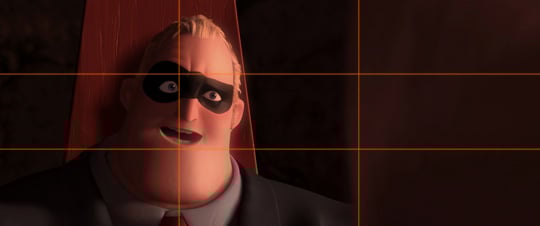
Unconventional Framing
Most directing styles frame by the “Rule of Thirds,” which basically means placing characters off to the left or right of frame slightly. Unconventional framing is mix the character placement or explore the visual space of your frame by placing characters in unconventional spots.

Depth of FieldDepth of Field is defined as the range of acceptable focus on a shot or photograph. Depth of field is an important concept for cinematographers and camera operators to master because they often need to manipulate focus to achieve a desired effect. Selective focus, for instance, draws the audience's attention to a specific portion of the frame. Depth of field can also be either shallow or deep. Shallow depth of field is the kind in which part of the frame is soft or out of focus. Thus, the areas of focus or sharpness are limited. Deep depth of field, on the other hand, is the kind in which the entire frame, from the foreground to the background, is sharp or in focus.
Lenses
Zoom lenses (or varied focal length lenses) - most common type of lenses. Has an advantage over prime lenses because it doesn't require constant lens changing to get a tighter or wider composition. This choice of lens is ideal for documentary and news gathering since, in both situations, the operator doesn’t have the luxury of pre-planning, rehearsals, and second takes. The disadvantage of zoom lenses is the loss in image quality.
Prime lenses (or fixed focal length lenses) - can’t zoom in or zoom out. Therefore camera needs to move every time a composition changes. As a trade-off for the inconvenience of switching lenses, the image quality is far superior with prime lenses, offering more pristine, clearer recordings.
Camera Movement
Dolly - The camera is mounted on a cart which travels along tracks for a very smooth movement. Also known as a tracking shot or trucking shot.
Handheld - The camera physically follows the subject at a more or less constant distance but with a shaky movement.
Pan - Horizontal movement, left and right.
Tilt - Vertical movement of the camera angle, i.e. pointing the camera up and down (as opposed to moving the whole camera up and down).
Track - Roughly synonymous with the dolly shot, but often defined more specifically as movement which stays a constant distance from the action, especially side-to-side movement.
Camera Angles
Angles guide the judgements and perceptions made about the subjects. There are a couple of ways in which angles broadly fall under: subjective camera and objective camera. A subjective camera angle immerses us into the sensations and feelings of the scene and subject, as if we are part of that experience. An objective camera is that of a third-party observer, like one watching a scene play out.
Angles have two main intended effects, omniscience and experience. Omniscience is an objective point of view, meaning that there is a clear separation between the viewer and the subject. When the camera angle allows for a very objective and neutral point of view i.e without any low or high angles, the viewer gets the opportunity to see the scene just as it is. On the other hand, experience using subjective camera forces the viewer into the scene, eventually associating himself with the story.
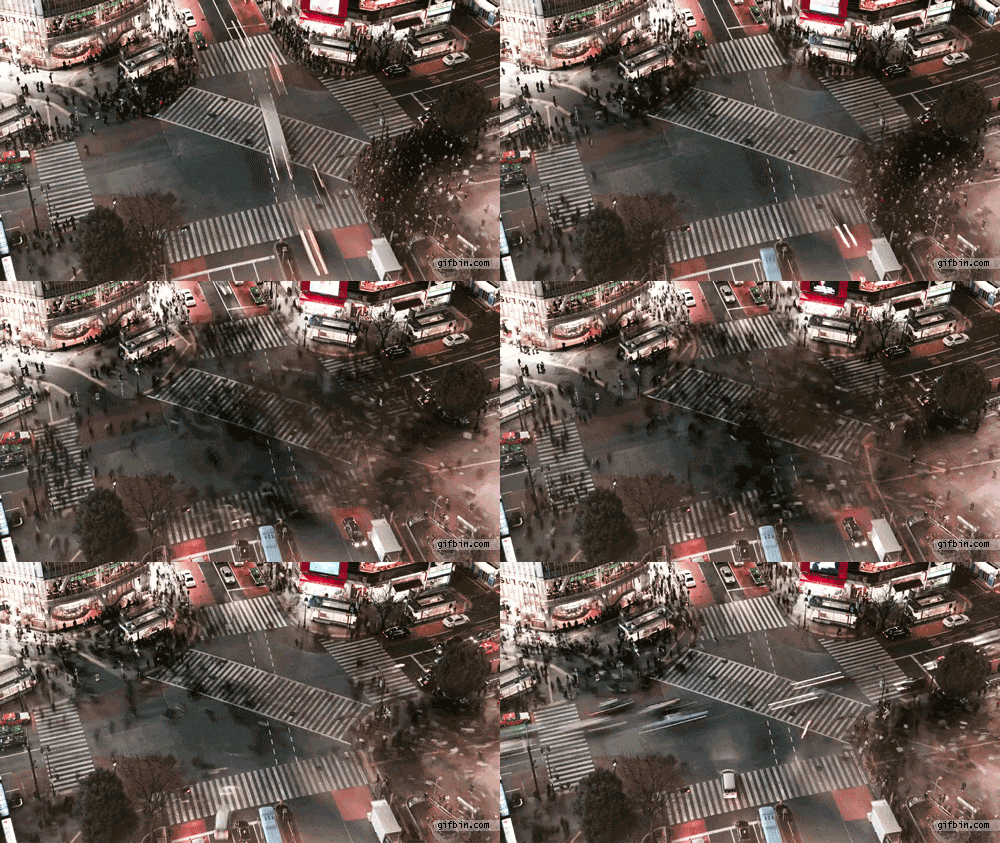
This angle presents a scene from overhead. This shot puts the viewer in an omniscient position being able to view all meaningful elements. It makes people look ant-like who effectively play a part in the bigger scheme of things
Low Angle

This angle captures the subject from a low angle. Thus, it projects the subject to be powerful, superior and dominant. The subject will appear dramatically and maybe even unnaturally tall. In contrast, the viewer might experience weakness, powerlessness, insecurity, helplessness etc in relation to the subject.
High Angle

In this angle, the camera captures the action from an elevated position using a crane. High angles make the subject seem smaller, inferior and unimportant.
Eye-Level Angle

This is a fairly neutral shot. The shot looks close to reality as the angle makes it look like an actual human observing the scene. This is the most used angle of all. It shows people the way one would expect to see in real life. Psychologically, since one sees eye-to-eye with the person, one perceives them as a peer having equal status and power. The eye-level angle comes under subjective camera because the shot encourages the viewer to identify with the subject. Because the angle typically feels natural, the viewer might not even consciously view it as an angle.
Point of View Angle

In this type, the subject looks directly at the viewer, or at someone or something far to the left or right. The resulting image will most likely produce the same psychological effect as an eye-level angle. Or, the viewer becomes the subject looking from his or her point of view. This one is an interesting blend of both a subjective and objective camera angle. Even though the shot gives the impression that the viewer is standing right there and being a part of the conversation for instance, one also tends to feel like an unnoticed spectator in the situation.
Lighting
Lighting is largely responsible for influencing and dictating how you’re going to feel on different shots. It also helps deliver an idea of the location and time in the setting. It directs attention, and makes the subjects appear completely natural and attractive at the same time. All lighting can broadly be categorised as “hard” with sharp and distinct shadows, or “soft” with less-defined, softer shadows and fewer background images.

Great post - but please remember to cite your sources. Thanks, Sylvester!
ReplyDelete