It refers to the comparison of key light (the main source of light from which shadows fall) to the fill light (the light that fills in the shadow areas). The higher the lighting ratio, the higher the contrast of the image; the lower the ratio, the lower the contrast. Since the lighting ratio is the ratio of the light levels on the brightest lit to the least lit parts of the subject, and the brightest lit are lit by both key (K) and fill (F), therefore the lighting ratio is properly (K+F):F although for contrast ratios of 4:1 or more, then K:F is sufficiently accurate.
A ratio of 1:1 means that the lighting from the Key and Fill are equal. Eg F/8 and F/8.
A ratio of 2:1 means that lighting from the Key is brighter by a stop from the Fill. e.g. F/8 and F/5.6.
A ratio of 4:1 also means that the Key is 3 stops higher than the Fill. e.g. F/8 and F/4.

Inverse Square Law
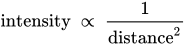
an inverse-square law is any physical law stating that a specified physical quantity or intensity is inversely proportional to the square of the distance from the source of that physical quantity. The fundamental cause for this can be understood as geometric dilution corresponding to point-source radiation into three-dimensional space (see diagram). Mathematically formulated:

Thanks, Sylvester. Please note that there is 2 stops difference between f8 & f4 (not three), but yes - this is a ratio of 4:1
ReplyDelete